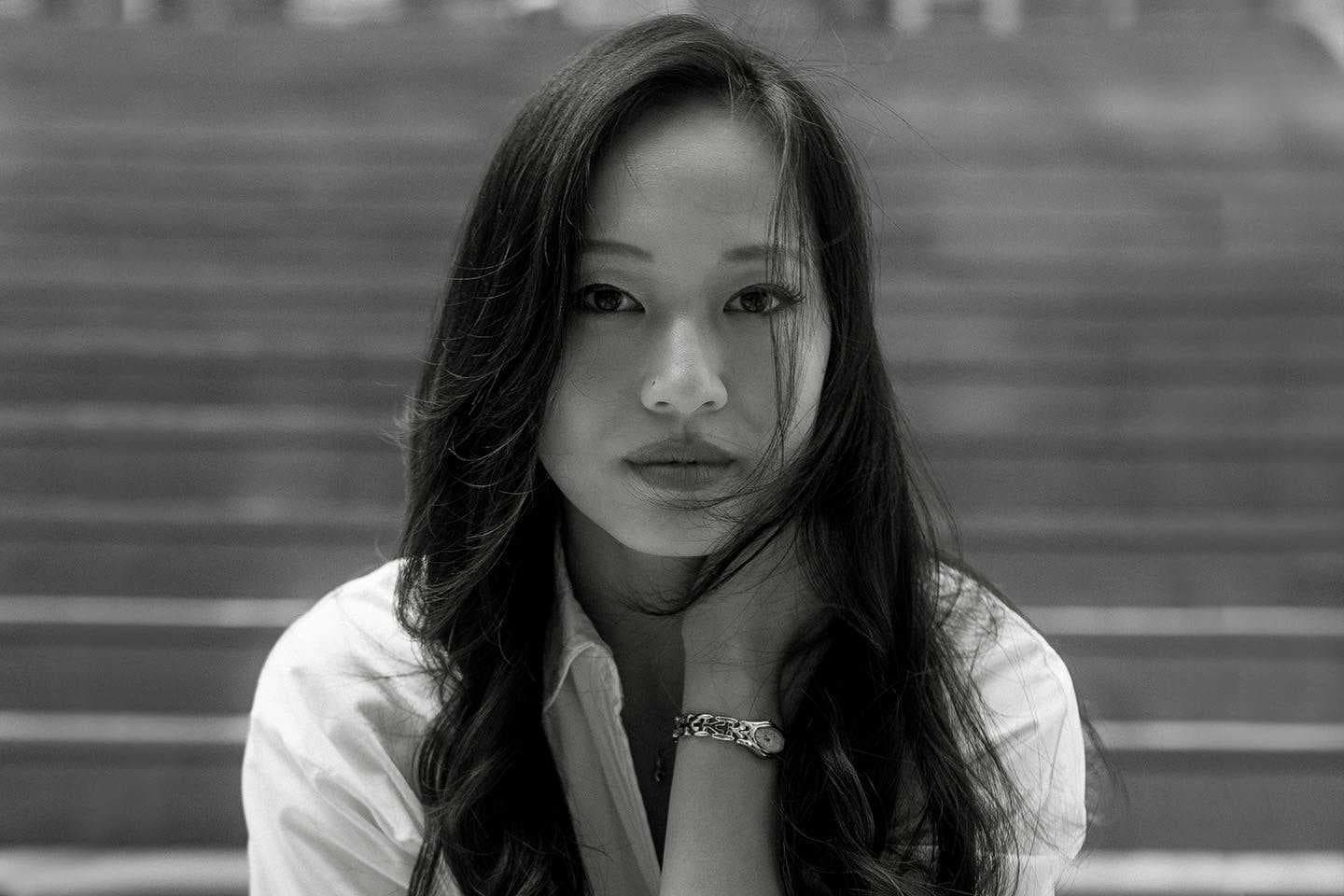
Angelene Wong '19
Bridging Fashion Theory and Practice
Fashion Studies (MA)
When Angelene Wong arrived at Parsons Paris to pursue an MA in Fashion Studies, she had already begun building a career in fashion writing and marketing in Singapore. What she sought next was not a change of field but a way to think more critically about fashion as a cultural practice. “I spoke with the program director, Marco Pecorari, before applying,” she says, “and he helped me realize that Fashion Studies at Parsons Paris offered exactly what I was looking for—a program that balances theory and practice.”
Wong found that balance both in Paris and at The New School. Immersed in a city shaped by fashion, performance, and the humanities, she expanded her critical vocabulary and began reimagining fashion as both an embodied practice and a global system. As she puts it, the program trained her to “think and do in equal measure.” Its interdisciplinary structure also encouraged her to move beyond the traditional boundaries of fashion studies to draw on performance theory, philosophy, and cultural analysis.
In her MA thesis, “The Metamodernist Body: Reconsidering Time, Space, and Free Will through 21st-Century Fashion-Dance Performance,” Wong examines the work of Hussein Chalayan, Jean Paul Gaultier, and Gareth Pugh to shed light on the way the moving body is reframed in contemporary fashion. Developed under the guidance of Wong’s advisors, Pecorari and faculty member Paul Jobling, the project bridged design, performance, and theory, laying the foundation for research she continues to pursue today.
“Both of my advisors were integral guides throughout the process,” Wong says. “They pushed me toward key readings while giving me space to explore new ideas.” Encouraged to engage with thinkers such as Henri Bergson and Gilles Deleuze, she also developed an interest in performance analysis. The project deepened her understanding of the use of archives to study live performance and of the productive tensions between fashion and costume design in the context of theater.
Working in Paris, a city rich in museums and archives, further shaped Wong’s scholarly development. During her studies, she interned with Jonathan Cohen and Talbot Runhof during Paris Fashion Week, an experience that complemented her coursework on creative labor and the backstage of fashion. She collaborated on class projects with institutions including the Palais Galliera, MoMu Antwerp, Koché, and Madame magazine. Through a research grant, she traveled to London to study the Sadler’s Wells Theatre archives for Hussein Chalayan’s dance piece Gravity Fatigue. Her research at the Centre National de la Danse informed her analysis of both Chalayan’s work and Jean Paul Gaultier’s Fashion Freak Show. Seeing the show at the Folies Bergère in 2018 provided Wong with a firsthand perspective that deepened her research. “Those archives opened my eyes to the range of resources available for this kind of research,” she says. “I foresee returning to them for future projects.”
Reflecting on the experience, Wong notes the distinctive balance the program offered. “You gain access to collaborations and archives in Paris and Western Europe while still working with the critical lens of The New School.”
Wong also points to the small size of the Parsons Paris cohort as an important aspect of her experience. “The Paris class was much smaller than New York’s, which meant closer collaboration with faculty,” she explains. “Every class was formative in its own way.” Although based in Paris, Wong also spent time at The New School’s New York campus, where she took courses on fashion journalism, fashion and memory, and fashion and human rights. Working with faculty members such as Heike Jenss, Rhonda Garelick, Benjamin Lee, Sakiko Fukuda-Parr, and Mary Watson added new dimensions to her education.
Wong cites Hazel Clark, Justin Morin, Giulia Mensitieri, Emilie Hammen, and Laurent Cotta, in addition to Pecorari and Jobling, as important influences at Parsons Paris. Under their guidance, she developed the ability to move fluidly between theory, archival research, performance analysis, and fashion practice.
After completing her master’s degree in 2019, Wong returned to Singapore to begin PhD studies at Nanyang Technological University’s School of Art, Design and Media and to teach at LASALLE College of the Arts. In her doctoral studies, she drew heavily on the interdisciplinary foundation she had developed at Parsons Paris. “Praxis became central to my thinking,” she says, describing the integration of theory and practice emphasized there. “The education at Parsons gave me the courage to question phenomena we often take for granted. It has guided my work in Singapore, where fashion research has a lot of potential.” The theoretical frameworks she explored—particularly postcolonial approaches—became essential tools for examining global hierarchies in the fashion value chain. “Parsons taught me to see fashion as a global system and to recognize when theories need to be adapted—or rethought—for local contexts,” she explains.
Wong’s doctoral dissertation, “Fashion Modeling, Poses, and Modern Femininities in Singapore, 1965–1987,” introduced somatic mimesis, a practice-led method that involves assuming poses drawn from fashion archives. Bringing together performance studies, fashion media analysis, and her background in dance, Wong examined the way poses in Singaporean magazines shaped ideals of femininity at a time of rapid social transformation. “Fashioning is an embodied practice,” she explains. “I wanted a method that could bring the moving body into archival research.” Somatic mimesis offered a means of interpreting history that transcended visual analysis alone.
In 2025, Wong was awarded the NTU Graduate College Interdisciplinary Research Award, an honor given to just one arts and humanities student in the graduating cohort. After receiving her doctorate, Wong joined the Singapore Fashion Council, where she led initiatives supporting the retail sector. Working at the intersection of industry and government expanded her understanding of fashion’s regional and global challenges. She also contributes to the Singapore Fashion Histories project, engaging with fashion research across a range of cultural and institutional contexts.
Now an early-career researcher at what she describes as an “inflection point,” Wong focuses on publishing, teaching, and continuing to develop methods that challenge conventional approaches to fashion practice and research. She envisions a hybrid practice that links academia and industry. “I do believe there needs to be a bridge,” she says. “I’m most excited about doing work with people who share that commitment.”
Asked to describe the MA Fashion Studies program for prospective students, Wong responds, “It’s a rigorous and demanding program, but it prepares you to approach fashion both creatively and critically. For me, it opened doors to mentors, teaching, and international collaborations.”