When Xiao Xu arrived at Parsons Paris to begin the MFA Fashion Design and the Arts program, she was already thinking beyond garment construction. Although she had considered studying fine art, she ultimately decided to pursue a medium that allowed her
to explore her interest in the human body, materials, and emotional expression. Fashion, as a practice in which ideas, movement, and meaning converge, offered that opportunity.
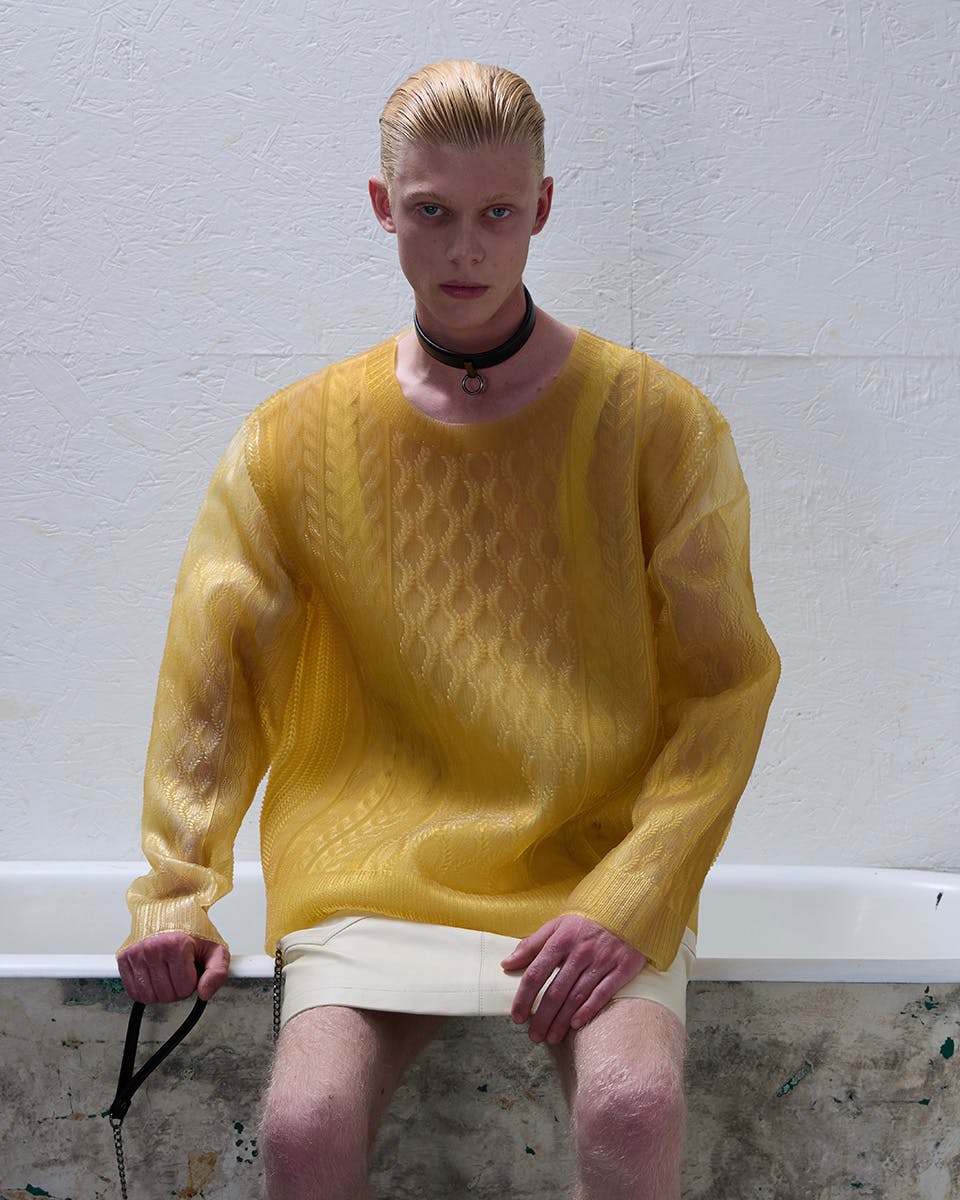
 Model Paul Lemoine wears a translucent yellow knit by Xiao Xu, its textured surface and soft volume contrasting with minimal styling to reframe traditional menswear silhouettes. Photography: Boyan Li. Model: Paul Lemoine.
“Most of my expression revolves around the human body,” Xu explains. “Fashion allows me to combine making clothing and visuals as well as styling and casting—all in one system.” The MFA program’s cross-disciplinary structure, she adds, strongly supported
her interest in art and materials experimentation. Drawn to the program by its distinctive educational approach and hands-on mentorship, Xu found an environment that brought together conceptual exploration with the realities of the fashion world.
“Parsons Paris is closely connected to the industry,” she says. “Its teaching approach is very similar to the way work is done within a fashion house. The structure of projects and the way faculty guide students reflect real working methods rather
than purely academic exercises.”
That mentorship continues to shape her design practice today. Program director Tuomas Laitinen helped her develop a methodology for turning powerful concepts into collections that are both coherent and desirable to customers. “Tuomas taught me how to
design and make garments in a more refined way,” Xu says. An art course with Mads Dinesen encouraged her to stop pursuing perfection and embrace an experimental approach—an influence that carried through to her thesis work. “Mads continuously encouraged
me to explore different artistic directions,” Xu notes. “I later translated these explorations into a design methodology and integrated them directly into my fashion projects.” Instructors Janette Laakso and Miki Omori provided essential guidance
on craftsmanship, helping Xu employ materials and navigate construction challenges.
Beyond the classroom, Xu greatly benefited from Parsons Paris’ industry partnerships, including a collaborative project with Mugler, the fashion house founded by designer Thierry Mugler. Working with the house’s codified design language forced Xu to balance
a strong brand identity with her own emerging aesthetic, challenging her to adapt while incorporating her own point of view. The results of those lessons can be seen in Xu’s MFA thesis collection, titled Uncanny. Drawing on fetish culture and the
visual milieu of the 1970s, the collection explores the intersection of embodied experience, cultural identity, and material. “The 1970s was an era in which people were willing to explore new territories—fetish, punk, glamour,” Xu explains. “I wanted
to bring back something unexpected and provocative in today’s more restrained cultural context.”
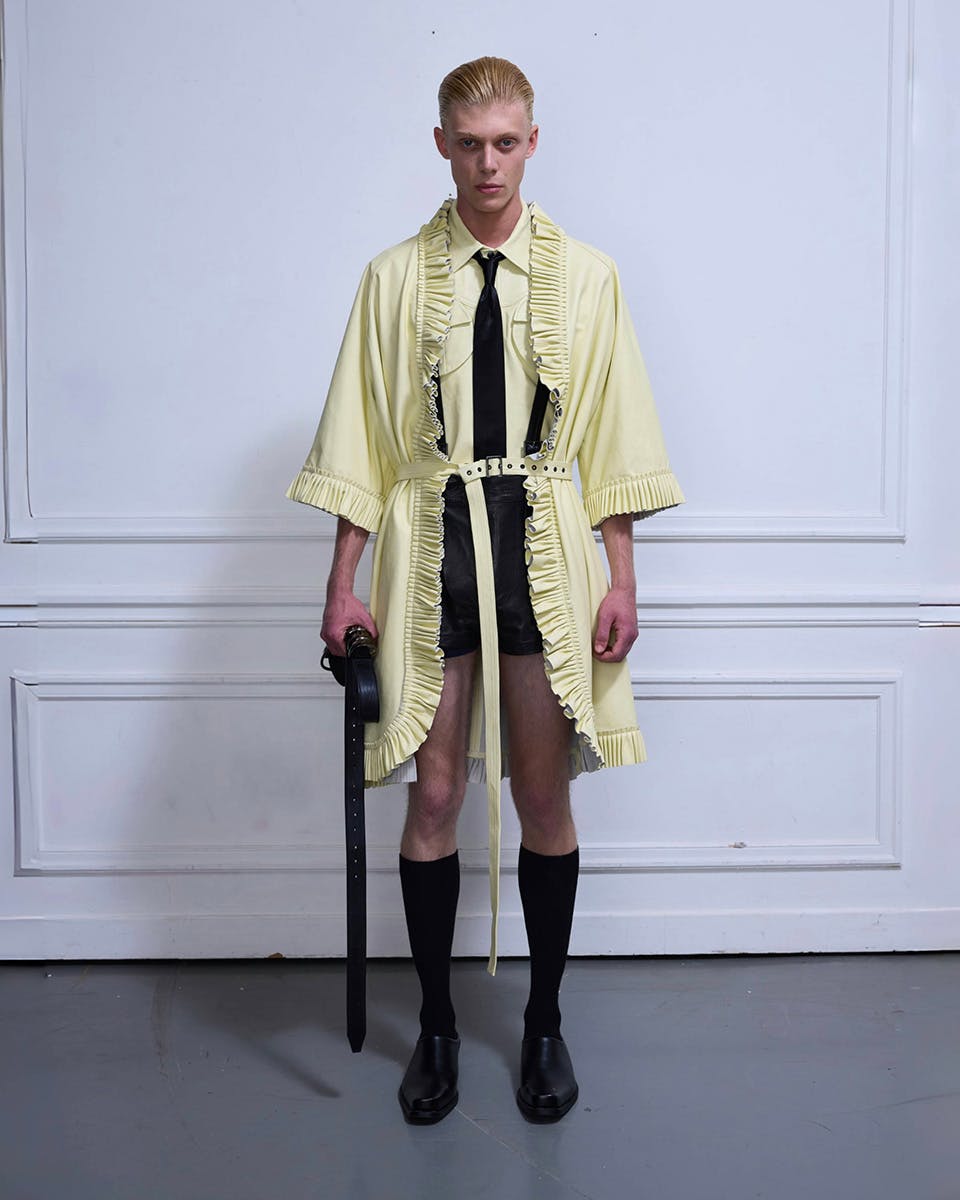 Model Paul Lemoine wears a tailored look by Xiao Xu, combining a pale yellow, pleated coat with structured layering and contrasting black elements that reinterpret classic menswear codes. Photography: Boyan Li. Model: Paul Lemoine.
Xu’s research began with a viewing of Dressing for Pleasure, a British film from 1977, and expanded into archival and documentary material and visual histories of subcultures. Paris’ cultural resources played a key role in shaping her research-driven
approach. “Regular visits to exhibitions at fashion archives, libraries, and museums helped ground my work in historical and material culture research,making my design process more solid and considered rather than purely intuitive,” she says. Early
scenes of people in latex—in contexts that seemed intimate but not sensational—captivated her. “I didn’t want to make traditional fetish fashion,” she adds. “I wanted to combine it with art to create something personal and new.” Other influences ranged
from fetish publications like AtomAge, founded by John Sutcliffe, to conceptual artists such as Rachel Whiteread, whose investigations of form and absence helped shape Xu’s thinking about material presence.
Materiality became a central concern in Uncanny. Xu gravitated toward latex and leather for their potential to be reinterpreted. She experimented with contradiction—rendering latex as knitwear and softening leather into fluid, ruffled forms—to unsettle
expectations. Studying fashion in a European context further sharpened her perspective. “It led me to realize that strong design and strong craftsmanship cannot be separated,” she explains. “Beyond concept, a garment must first be a well-made piece
of clothing, with material quality and construction treated as essential parts of the design.” Xu found these experiments both rewarding and demanding. Developing latex knitwear, for example, involved extensive trial and error. “It was very time-consuming,
and dealing with the emotional challenge of continually refining work was one of the biggest parts of the project,” Xu recalls.
The hands-on faculty mentorship provided at Parsons Paris was essential throughout the process. Laakso and Omori worked closely with Xu on experiments with finishing methods and construction solutions. “Their support helped me integrate multiple systems
within a single piece,” she says. Beyond addressing technical challenges, these collaborations developed Xu’s ability to make decisions about materials and gave the collection cohesion and depth.
The diversity of the Parsons Paris community also played an important role in Xu’s development. “Working in a diverse environment had a positive impact on my practice,” Xu reflects. “Being exposed to different cultural backgrounds and ways of thinking
expanded my perspective, and observing other students’ work helped complement and enrich my own understanding of the world.”
Uncanny reflects Xu’s conviction that fashion and sexuality are inseparable. Although Xu regards contemporary fashion as governed by conservatism—driven in part by cultural uncertainty—she remains committed to producing work that is exploratory rather
than traditional. “What matters most is whether it has something interesting to say,” she explains. “I don’t want to create something simply because it feels conventional.” Since beginning the MFA program, Xu says, her practice has become “more mature
and focused.” She notes that she has “gradually moved from being mainly concerned with self-expression to being more attentive to craftsmanship, construction, and the garment itself.”
When asked by prospective students about her experience at Parsons Paris, Xu emphasizes both the opportunities the school provides and the rigor of its pedagogy. “Not only can you expect brand collaborations and close engagement with the industry, but
you also will gain a more mature design methodology and find the space to explore and develop your own practice. The students who thrive most are those willing to experiment, take risks, and actively try new approaches.”
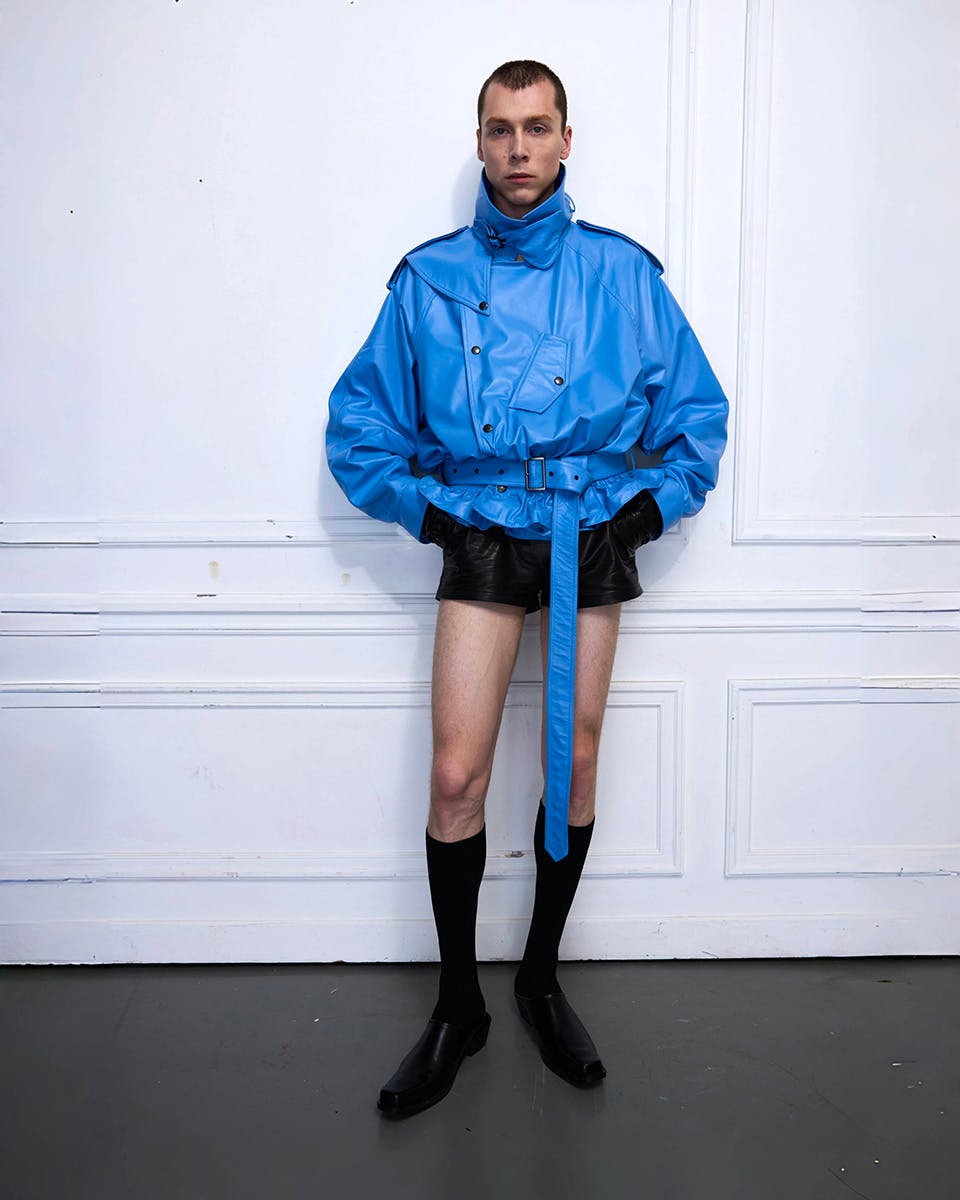
 Model Matéo Picard wears a structured blue outerwear look by Xiao Xu, featuring exaggerated volume, a cinched waist, and utilitarian detailing that reinterprets classic menswear silhouettes. Photography: Boyan Li. Model: Matéo Picard.
Xu plans to continue exploring unconventional concepts of masculinity and to bring her latex-shaping techniques into ready-to-wear contexts. She is eager to collaborate with artists and established designers who can broaden her conceptual and material
vocabulary. For Xu, fashion remains a space of inquiry—where material, body, and identity converge in unexpected and expressive ways.