
Menswear Fashion Designer
Fashion Design (BFA), 2024
He/him
Language Spoken: English, German, Mandarin, French
Ho Tin Albert Chan, originally from Hong Kong, moved to Germany with his family at a young age. He attended the Cecilien-Gymnasium in Düsseldorf, with a bilingual program, and participated in pre-college programs majoring in art and design in the US. Beyond academics, he embraced various artistic pursuits, from music to martial arts. His journey in art started with sketching as a child, progressing to painting, advanced drawing, and eventually exploring 3D art and sculpturing. His interest in fashion design deepened and was sparked during pre-college programs, becoming a lasting passion. Despite pursuing a career as a menswear designer, Albert remains open to new inspirations, continuously seeking personal and artistic growth.
Das Rudel
Fashion Design (BFA), 2024
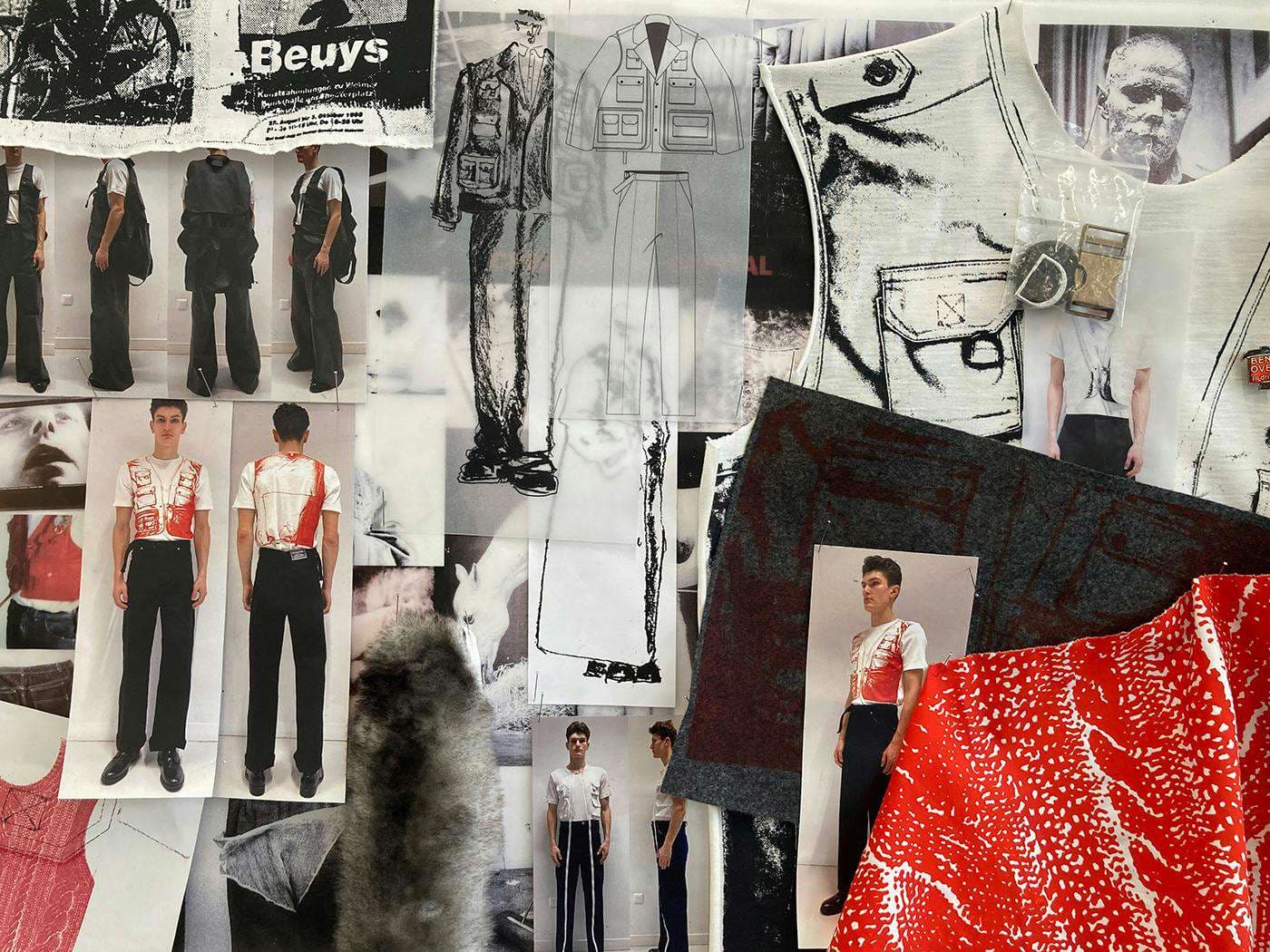
The aim of my thesis collection is to contribute to the wider discourse about fashion as art by examining the work and wardrobe of German artist Joseph Beuys. Born under the Third Reich, Beuys was serving as a pilot in the Luftwaffe when his plane was shot down over Crimea in 1944, leaving him severely injured. Fortunately, he was found and rescued by a group of nomadic Tartars, who wrapped him in felt and fat and nursed him back to health. This transformative experience, frequently recounted by Beuys, profoundly shaped his artistic philosophy, making him view materials such as felt and fat as symbols of healing, warmth, and protection. My collection aims to blend Beuys’s artistic archive with his iconic uniform: hat, fisherman’s vest, white shirt, and blue jeans. The blending is achieved through methods of deconstruction. While the 2D process is heavily collage-driven by cutting pictures of garments and assembling their key elements on a surface, the 3D process aims to imitate the 2D by draping with existing garments as used in the collages and further developing aspects such as silhouette and details on top. The key of this collection is to integrate the utilitarian elements of the fisherman jacket, which include a variety of pockets with velcro, snap, and zip closures, as well as D-rings, buckles, and harnesses for the hardware, finished with quilting and bias tape within all of the garments. The research on Beuys’s wardrobe goes beyond his uniform. Other garments include fitted T-shirts, high-waisted straight jeans, oversized tailored jackets and trousers, knitted sweater vests, military rucksacks, fur coats, and great coats. In addition, the collection will also focus on prints and fabric manipulation by taking a deeper look into Beuys’s graphic work, which is rich in symbolism and typography.