
Katayoun Chamany
Mohn Family Professor of Natural Sciences and Mathematics; Department Faculty Advisor of Interdisciplinary Science
Email
katayoun@newschool.edu
Office Location
B - 65 West 11th Street
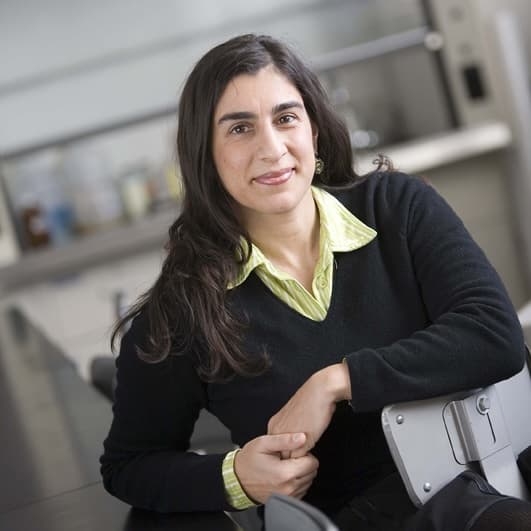
Profile
* Mohn Family Professor and Chair of the Department of Natural Sciences and Mathematics at Eugene Lang College for Liberal Arts
* Chair and Academic Advisor of the Interdisciplinary Science Program
* Director of the University Academic Science Labs
* Faculty in Residence at Kerrey Residence Hall at The New School
Katayoun is an educator, advocate, and mentor. She is the founder of the Interdisciplinary Science Program; an undergraduate program that empowers students with the knowledge, values, and methods of science to address pressing planetary health challenges. She has developed and implemented interdisciplinary science courses using a Planetary Health Framework. Her courses include an infectious disease course for graduate students studying International Affairs, a week-long intensive lab course for Design and Technology students competing in the national Biodesign Challenge, a short course connected to the New Wave Science Film Festival, a mentoring course for undergraduates alongside a summer fellowship program with Biobus, and a summer bridge course, Biology, Art and Social Justice, for incoming freshman participating in the Higher Education Opportunity Program (HEOP). She hosts faculty development workshops on infographic thinking, case studies, critical pedagogy, meta cognitive reflection, and authentic assessment to promote scientific innovation that is socially just. She has served as a Monitoring Editor and Reviewer for Life Sciences Education journal and Editorial Board member for The National Center for Case Study Teaching in Science. As a Leadership Fellow for Science for New Civic Engagements and Social Responsibilities (SENCER), Katayoun designed the open access Stem Cells Across the Curriculum that employs STREAMD (STEM + Arts, Design and Responsibility) perspectives.
She is the recipient of The New School Distinguished University Teaching Award, The Eugene Lang College Excellence in Academic Advising, and the University Excellence Award for Social Justice Teaching. At the national level she received the John A. Moore Award for Science as a Way of Knowing by the Society of Integrative and Comparative Biology and the William E. Bennett Award from SENCER for Extraordinary Achievements in Citizen Science. She graduated with a Ph.D. in Cell and Molecular Biology from UC Berkeley in 1996 and prior to Eugene Lang College she was a visiting professor at UC Berkeley, Pomona College, and Harvey Mudd College.
Office Hours Tuesdays 12-1:00pm and by appointment (Room U618)
Degrees Held Ph.D. Cell and Molecular Biology UC Berkeley 1996 B.A. Biology University of Iowa 1989
Professional Affiiliations American Association for the Advancement of Science
The New York Academy of Sciences
The American Society for Cell Biology
The International Society for Stem Cell Research
Project Kaleidoscope, (PKAL) Faculty for the 21st Century
Leadership Fellow for Science Education for New Civic Engagements & Responsibilities
Editorial Board Member of the National Center for Case Study Teaching in Science
Editorial Board Member of the journal CBE-Life Sciences Education
Member of the Steering Committee of Symbioses
Member of the Narrative, Health and Social Justice Seminar at Columbia University
Research Interests
Curriculum development and student learning outcomes assessment (biology in context, and STEAMD); the role of motivation and interest in student learning of biology; infographic thinking; case based teaching and learning; social justice/ critical pedagogy; stem cell research; the ethics of oocyte provision; public perception and understanding of new biotechnologies and reproductive technologies (ART, PGD, Genetic testing); standard of care and informed consent; HPV and its associated diagnostics, treatments, and vaccines; indigenous knowledge and resources as they related to benefit sharing; health as a human right.
Performances and Appearances Is Home Where the Body Is? Aug 2025. Making Home Biennial Cooper-Hewitt/Smithsonian Museum. Discussion with Information Artist and BioHacker, Heather Dewey-Hagborg. Link . Discussant/Presenter.
Science +Art +Design Lab Workshops. 2015-2020. Series of open labs spanning synthetic and biotechnologies hosted by The New School and developed and organized by Katayoun Chamany and implemented with Marcus Allen Banks. 8 events per year.
Chamany, K. January 2018. Synthetic Embryos. POP A.R.T. Blog. Center for Genetics and Society. Blogger.
Chamany, K. November 3, 2017. The Vera List Center Prize for Art and Politics 2016-2018: International Biennial Prize Conference, "Seeds as Storyteller/Witness" panel. The New School, New York. Panelist.
Chamany, K. January 25, 2017. Research Congress. Science, Innovation, and Society Panel. Technologic de Monterrey. Monterrey, Mexico. Panelist.
Irvine, A. and Chamany, K. March 22, 2016. Whose Body, Whose Property, and What Choice? Biopolitical Times Blog. Center for Genetics and Society. Blogger, Organizer, Moderator, and Presenter Link
Chamany, K. November 19, 2015. New Rules Proposed to Address Privacy and Trust in the Precision Medicine Initiative. Biopolitical Times Blog. Center for Genetics and Society. Blogger. Link
Chamany, K. September 18, 2013. The Vera List Center Prize for Art and Politics 2013-2015: International Biennial Prize Conference, "Ecologies of Organizing” panel. The New School, New York. Panelist.
Chamany, K. and S. Lindee. 2005. Genetics and Human History. Odyssey Radio Program, Chicago Public Radio WBEZ 91.5 FM (NPR Affiliate). July 29.
Degrees Held
- Ph.D. Cell and Molecular Biology UC Berkeley 1996
- B.A. Biology University of Iowa 1989
Recent Publications
Curriculum Development Projects
Chamany, K. and Banks M. 2016-2022. Science +Art + Design Lab Modules. A collection of stand alone lab modules custimizable for non-majors and majors in sustainability topics that include: Sustainable Cities (Water and Waste), Sustainable Plastics (Biopolymers), Sustainable Food *GMOS), Sustainable Populations (Tissue Regeneration) and Sustainable Color (Microbial Pigments). Each module is accompanied by bibliography, worksheets, vocabulary, stlide sets and protocols.
Chamany, K. et al. March 2016. Stem Cells Across the Curriculum. An open access modular curriculum using case based teaching and learning, infographic thinking, and a social justice framework. Link
Chamany, K. 2006. Cell Biology for Life. Garland Publishing. An open access modular curriculum designed to provide social context for traditional cell biology courses. Garland Publishing. Link
Chamany K. 2006. MDR Tuberculosis: A Case Study for Non-Science Majors Focused on Social Justice. National Center For Case Study Teaching in Science Case Collection. Peer Reviewed. Link
Chamany, K. 2001. Ninos Desaparcidos Case: A Case Study About Genetics and Human Rights Case and Teaching Notes. National Center For Case Study Teaching in Science Case Collection. Peer Reviewed. Link
Publications
Chamany, K. 2016. “Critical Pedagogy: Stem Cell Research as it Relates to Bodies, Labor and Care.” Studies in Social Justice. Forthcoming.
Chamany, K. et al. 2012. “Stem Cells and Social Justice: A SENCER Model Course.” Link
Chamany, K. 2011. “Introduction II: Buying and Selling The Body.” In The Body and The State: How the State Controls and Protects the Body. Part II. Social Research. 78 (3):823-827. Link
Chamany, K., Rubin, L. Paunova, E. and Pantuso C. 2010. “PGD for BRCA 1 and 2 Carriers Infographic and Information Pamphlet.” Link
Chamany K., et al. 2008. “Making Biology Learning Relevant to Students: Integrating People, History, and Context into (College) Biology Teaching.” Life Sciences Education. (7):267-278. Link
Chamany K. October 2006. “Science and Social Justice: Making the Cases for Case Studies.” Journal of College Science Teaching: 54-59. Link
Chamany, K. October 2006. “Introduction III. Health.” In Politics and Science: How their interplay results in public policy. Social Research. 73(3): 781-784. Link
Chamany K. 2001. “Ninos Desaparecidos: A Case Study About Genetics and Human Rights.” Journal of College Science Teaching. 3 (1):61-65.
Invited Workshops, Presentations, and Papers
Chamany, K. June 10, 2025. “Visual Thinking Strategies: STEAM & Power.” Letting Off Some STEAM: Getting Creative in STEM, Massachusetts Regional PKAL Meeting. Westfield State University, Westfield, MA. Presenter.
Chamany, K. August 4, 2022. Critical Biology & Reprojustice: Roe v. Wade. Science Education for New Civic Engagements and Responsibilities. Virtual Annual Summer Institute/Critical Contexts and Critical Pedagogies for STEM learning. Presenter.
Chamany, K. July 27, 2020. HeLa Cells & #BLM: Intersectional Analysis of Race, Gender, Class, and Biology. Science Education for New Civic Engagements and Responsibilities. Virtual Annual Summer Institute. Presenter.
Chamany, K. June 25, 2019. Scaffolding Case Studies, Role-Play & Deliberative Dialogue: Authentic Assessment. National Conference for Advanced POGIL Practitioners at Washington University. St. Louis, Missouri. Invited Keynote Speaker.
Chamany, K. July, 25 2019. Case Studies in the BMB Classroom: Tying Stories to Concepts, Principles, and Techniques. ASBMB Special Symposia: Transforming Undergraduate Education in the Molecular Life Sciences. American Society for Biochemistry and Molecular Biology. San Antonio, Texas. Invited Keynote Speaker.
Chamany, K. June 12, 2018. Visual Narratives of Biology, Bodies & Beliefs. FEM Meeting Women in Art, Science, and Technology. Sao Luis, Portugal. Invited Presenter.
Chamany, K. January 2018. From STEM to STREAMD: Responsibility, Arts, and Design for Inclusive Learning. Society for Integrative and Comparative Biology. San Francisco, CA. John A. Moore Lecture and Award .
Chamany, K. August 2017. SENCER and Your Academic Career: A Twenty-year Case Study. SENCER Summer Institute. SUNY Stony Brook University. Stony Brook, NY. Invited Plenary Speaker.
Chamany, K. April 2016. "Biology & Social Justice Case Studies: Scaffolding Learning for Authentic Assessment." 34th Conference of the Empire State Association of Two Year College Biologists (ESATYCB). SUNY Orange, Middletown, NY. Invited Presenter
Chamany, K. Pokrywka, N. and Russo-Tait, T. Nov 2015. “Stem Cells Across the Curriculum (SCAC) An Open Access Social Justice Educational Resource.” Faculty Resource Network: Advancing Social Justice. Washington, DC. Link Conference Paper.
Chamany, K., Schwartz-Orbach, L. and Riggs, R. October, 2015. “Critical Pedagogy: Bodies, Labor, and Care. Consuming Intimacies Symposium.” Social Justice Institute, Brock University. Saint Catharines, Ontario, Canada. Link to Presentation. & Link to Conference Paper.
Chamany, K. May 2015. “Scaffolding Role-play: For Interdisciplinary Evidence Based Dialogues.” Annual Summer Workshop National Center for Case Study Teaching in Science. SUNY, Buffalo. Buffalo, NY.
Chamany, K. June 2014. “Enhancing STEM Education: Interdisciplinarity and Information Design." UC Irvine, Department of Developmental and Cell Biology, Irvine, CA. Link Seminar Presentation.
Chamany, K. September 2013. “Biology and Social Justice Case Studies: An Innovative Approach for Reaching Diverse Populations.” National Center for Case Study Teaching in Science, Buffalo, NY. Workshop.
Conference Posters (* Designates Student Research Assistant)
Chamany, K. 2021. Exploiting Zoom for Inclusivity & Active Learning. AAC&U/Project Kaleidoscope Regional Network Meeting. Virtual Poster Presentation.
Banks, M., Chamany, K., Smyth, D. April 2019. Going Green in the Lab: Extent of ‘Green’Practices in Academic Labs Data Updated. STEM, Humanities, & Justice. MidAtlantic Regional Meeting. SENCER. Eugene Lang College, NY, NY.
Banks, M., Chamany, K., Smyth, D. Oct 2018. Going Green in the Lab: Extent of ‘Green’Practices in Academic Labs. Annual Metropolitan Association of College and University Biologists Conference. Queensborough Community College, Bayside, NY.
Chamany, K. and *Banks, M. June 2017. Development and Implementation of a Water Quality Testing Module Across the Curriculum: Science, Liberal Arts, and Art/Design Majors. University of Wisconsin-Madison. Madison, WI.
Chamany, K., Riggs, A., and Schwartz-Orbach, L., and Wargaski, J. June 2016 “Stem Cells Across the Curriculum: Educational Modules That Integrate Ethical Reasoning and Biology Learning Using Infographic Thinking and Case-Based Thinking.” International Society for Stem Cell Research (ISSCR). San Francisco, CA. Chamany, K., Riggs, A., and Schwartz-Orbach, L., and Wargaski, J. May 2016. “Stem Cells Across the Curriculum: Modules That Integrate Biology and Social Justice Learning Using Visual Narratives and Case Based Teaching.” NYSTEM Annual Conference/ Empire State Stem Cell Board. New York, NY.
Chamany, K. et al. December 2015. “Stem Cells Across the Curriculum (SCAC): An educational resource that integrates the biological and social dimensions of stem cell research using infographic thinking.” The American Society for Cell Biology Annual Meeting. Washington. San Diego, CA.
Chamany, K., Riggs, A.*, and Schwartz-Orbach, L*., and Wargaski, J. October 2015. “Sources of Stem Cells Radial Infographic, Adult Stem Cells Blood ZoomGraphic, and Embryo PGD Zoomgraphic In Stem Cells Across the Curriculum. Creative Intervention.” Consuming Intimacies Symposium, Social Justice Institute Brock University, Saint, Catharines. Ontario, Canada.
Chamany, K., Wargaski, J., Riggs, A.,* and Schwartz-Orbach, L.* May 2013. “Using Preimplantation Genetic Diagnosis to Teach the Biological, Ethical, and Social Dimensions of Stem Cell Research in an Undergraduate Curriculum-Biology, Bodies, and Beliefs.”12th International Conference on Preimplantation Genetic Diagnosis. Istanbul, Turkey. (ResearchGate)
Current Courses
- First Year Seminar
LNGC 1400 - Fall 2026 - MBL: Mathematical Modeling
LSCI 3503 - Fall 2026 - MBL: Ecosystem Science
LSCI 3516 - Fall 2026 - MBL: Coastal Watersheds
LSCI 3517 - Fall 2026 - MBL: Oceanography
LSCI 3518 - Fall 2026 - MBL: Microbial Ecology
LSCI 3519 - Fall 2026 - MBL: Marine Conservation
LSCI 3520 - Fall 2026 - MBL: Science Writing
LSCI 3551 - Fall 2026 - MBL: Ind Research Project
LSCI 4515 - Fall 2026 - Sustainable Systems
PUFY 1100 - Fall 2026
Future Courses
- BioDesign Lab
LSCI 2100 - Spring 2027 - MBL: Intro to Parasitology
LSCI 3507 - Spring 2027 - MBL: Stem Cells/Regeneration
LSCI 3508 - Spring 2027 - MBL: Fundamentals of Synapses
LSCI 3510 - Spring 2027 - MBL: Biodiversity: Marine
LSCI 3511 - Spring 2027 - MBL: Dynamic Camouflage
LSCI 3513 - Spring 2027 - MBL: MicrobeAcrossEnvironments
LSCI 3521 - Spring 2027 - MBL: Embryology
LSCI 3522 - Spring 2027 - MBL: Science Writing
LSCI 3551 - Spring 2027
Past Courses
- Genes, Env. & Behavior
LSCI 2040 - Spring 2026 - BioDesign Lab
LSCI 2100 - Spring 2026