Rania Dalloul
When Rania Dalloul, MA Theories of Urban Practice ’15, visited Al-Ahmadi, the Kuwaiti colonial oil-company town where her family formerly resided, she found little trace of relatives in the official history. “Government archives contain hundreds of photographs, yet almost none of Arabs,” she says. “What happened to the Arab communities? After transforming Al-Ahmadi into a modern city, where did they go?” Her thesis and graphic memoir, Al-Ahmadi, shown above, engages with those questions. “By redrawing people into their own spaces and memories, it’s possible to secure representational justice for those left out of history.”
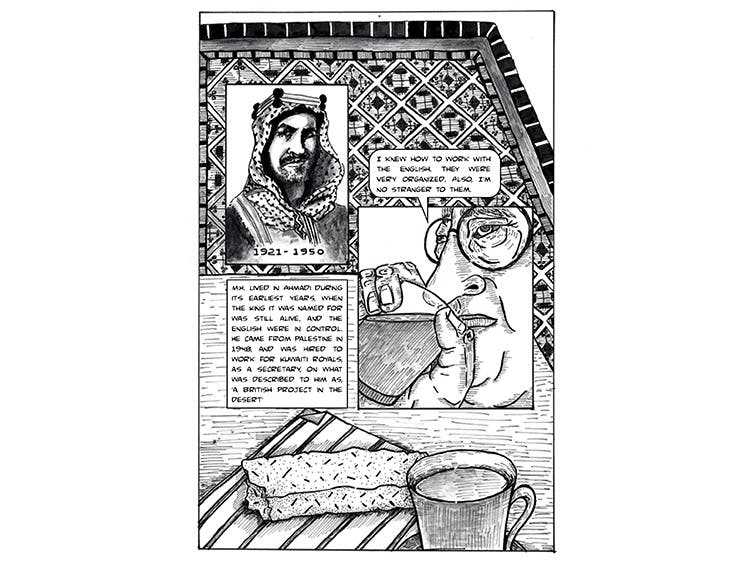
Dalloul chose her thesis format to “communicate across language barriers, education levels, and learning styles.” She interviewed oil company employees who had worked during the colonial period. Her narrative raises more questions than it answers, presenting readers with conflicting personal accounts of modernization, racism, and ethnic division—all contextualized by labor, urban design, and human geography. Describing her project’s final form, which departs from that of her usual work, Dalloul says, “Professors and peers urged me to expand my project to include spatial and architectural practices. With their support, I found the courage to experiment.”