Kiara Villa
(Re) Claiming Archives
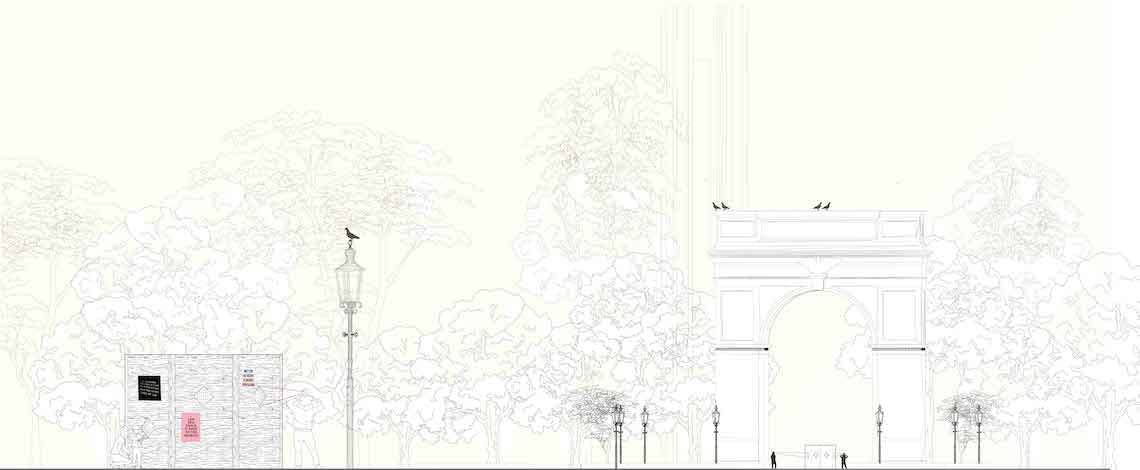
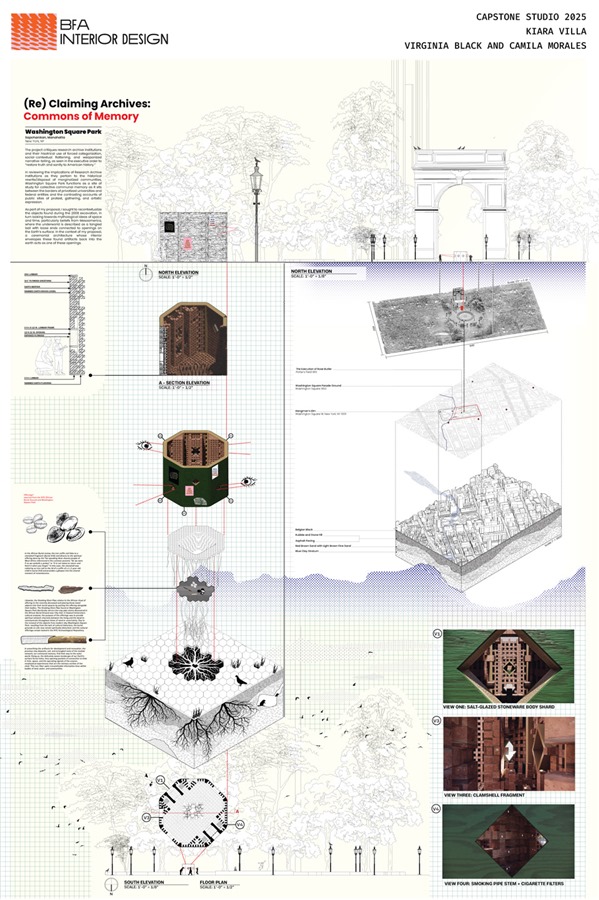
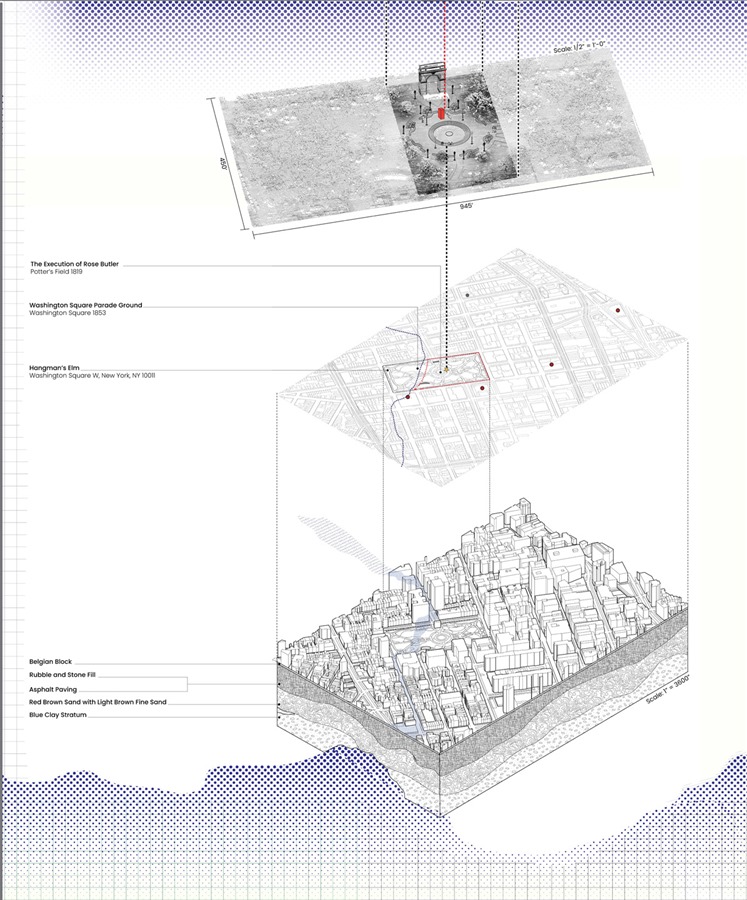
My capstone project, (Re) Claiming Archives, critiques the role of research archive institutions in shaping dominant narratives—the way they have historically flattened social context, enforced categorization, and controlled memory. The idea of memory—unfixed and alive—guided my exploration. I began by studying Washington Square Park archaeologically, focusing on its 2008 excavation. During the renovation, artifacts were unearthed in the layers of soil, now held in digital form in the NYC Repository. The layers of sediment reveal stories. The base layer is made up of blue clay, indicating the presence of ancient waterways, such as Minetta Creek, which flowed through an area that was home to the Lenape people. Above that are layers of fill and industrial debris, deposited during the period beginning with colonization. At the top is the surface we walk on today.
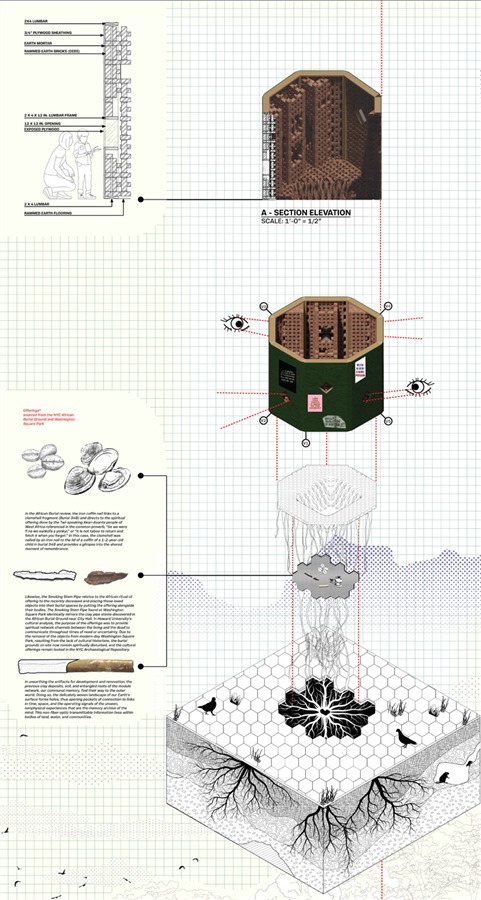
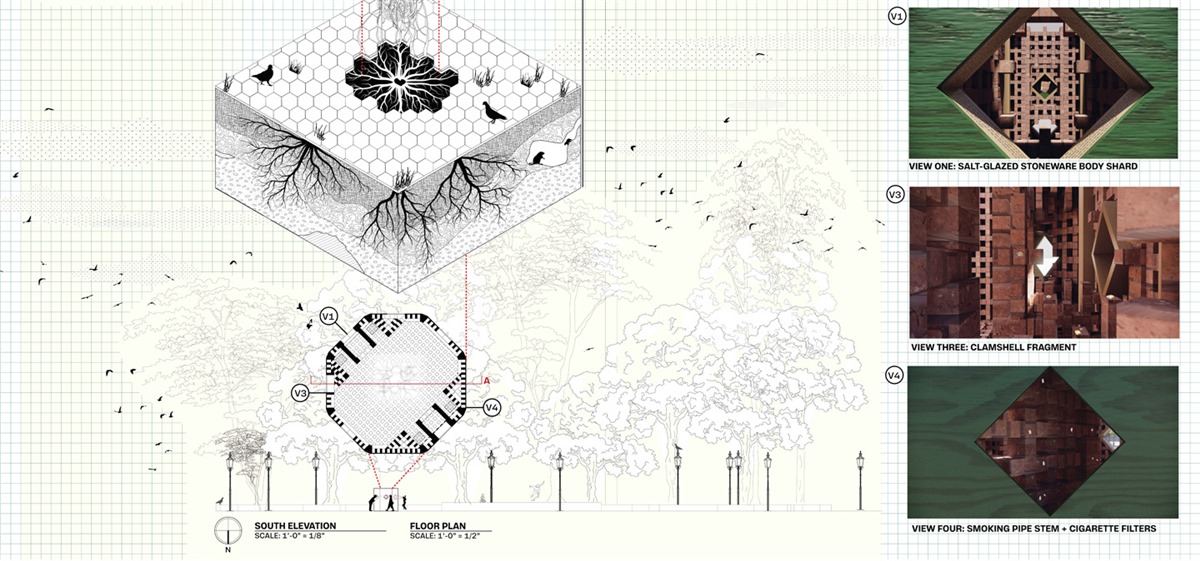
For my proposal, I drew inspiration from Mesoamerican cosmologies, in which the underworld is depicted as a tangled ball of string, with loose ends emerging through portals in the earth. My architectural intervention serves as one of these portals. This ceremonial structure re-integrates West and West Central African artifacts unearthed in 2008 into the soil, allowing memory to re-root itself. The structure I designed is a temporary pavilion that reflects both the city’s surface and the depth of the excavation. The exterior features hunter-green-painted plywood with cutouts, mirroring the fencing commonly seen on NYC construction sites. The interior features basket-woven earth block walls holding artifacts like offerings. At the center, the rammed-earth floor dips inward, exposing roots designed to honor the West and West Central African communities once buried beneath the park. The views from various standpoints—through the angled windows, at a kneeling observatory, near a portal facing the central pit—prompt the visitor to observe not only the objects but also the earth and the person on the other side. Visiting the structure reminds us that memory is not a solitary phenomenon. It is relational. It persists between people.
This thesis project contains copyrighted material, the use of which has not been specifically authorized by the copyright owner. I have determined this to be "fair use" of the copyrighted material as referenced and provided for in section 107 of the US Copyright Law. If you wish to use any copyrighted material from this document for purposes of your own that go beyond fair use, you must obtain express permission from the copyright owner.