FaDi Shayya
Leave No MRAP Behind: A Critical Materialist Account of Urban Imaginaries in Post-9/11 U.S. and Middle East (2016)
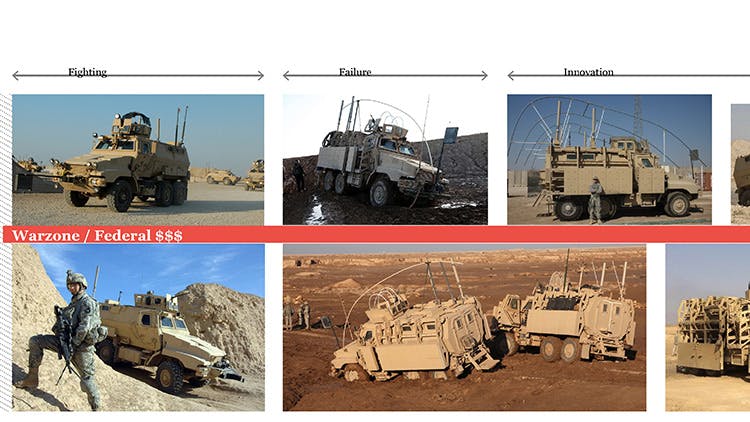
U.S. military MRAP (Mine-Resistant Ambush Protected) vehicles were originally designed to secure the bodies of American soldiers (as U.S. citizens) from the dehumanized bodies and lives of Afghans and Iraqis—citizens and soldiers alike. But over time, MRAPs have returned home and been reassigned to domestic law enforcement, only to perpetuate structural discrimination and violence along lines of class, race, gender, and nationality in the U.S. On May 1, 2015, a MRAP Caiman vehicle that once traversed Afghanistan’s or Iraq’s urban areas was outfitted as sheriff’s vehicle and was used in Baltimore, Maryland, to pacify and control Black Americans protesting against police brutality and the killing of Michael Brown in Ferguson, Missouri. This thesis investigates and documents how post-9/11 militarization processes and technomilitary strategies learned from experience in the Global South are used to administer the lives, bodies, and resources of American “second-class citizens” under the rubric of “homeland security.” The central point of the thesis is that the U.S. MRAP program has embodied the values of military technoscience, post-9/11 homeland security, Cold War legacies, and the colonial power of the U.S. political and corporate economies. From the warfare that creates the need for MRAPs to the rapid acquisition process that designs and procures them to the techno-material failure of the vehicles in the warzone, MRAPs become the embodiment of imagined security, the heirs of systemic and structural violence, and militarized commodities that shape urbanization both in the war zone and at home.
sds.parsons.edu/urban/tup/#1453953708631-b6e57580-af51f5bc-1284