Innovating the Urban Cycling Experience with Brompton Folding Bicycles
![An action shot of a student riding a bicycle [implementing their new designs?]](https://images1.cmp.optimizely.com/Zz0xMTk0NDlkMDQzNDYxMWYxYjkwMGI2ZDgxMjMxYjY0Yw==)
The partnership drew on Parsons’ embrace of urban centers as sustainable models for the future, underpinned by a strong emphasis on system-thinking design practices. Both of these hallmark approaches were needed to address the open brief: to engage with cycling, urban environments and transportation, cycling culture, and innovation in the design of new goods or services connected to their folding bikes. MFA student Craig Wei, a project participant, explains, “We weren’t asked to redesign the bicycle” to better integrate it into city living. “Instead, the brief made us think about how bikers would use Brompton for the next 50 years.”
The partnered course was led by School of Constructed Environments (SCE) associate dean Daniel Michalik and MFA Industrial Design program founder and professor Rama Chorpash. “Brompton is not a company looking for an exercise,” Chorpash says of the student–manufacturer relationship that unfolded from the loose directive. “Neither Brompton nor the Parsons students have the answers, and although the project involved a student competition, the ensuing search was an authentic, more equal endeavor.”
Many of the students' proposals extended beyond engineering modifications to the bikes; instead, they focused on supplemental projects like apps and transportation solutions that enhance accessibility and sustainability within the urban landscape.

Wei teamed up with fellow MFA student Melis Dizdar on three concepts. In the weeks leading up to their final presentation, they focused on a bike-mounted storage case that expands and contracts by means of an accordion-pleated textile. “Whether we faced a problem of urban bicycling or identified a problem that someone else is facing, it was our decision to surface that problem,” says Dizdar. “Brompton wanted to learn more about what makes us question things.” Dizdar and Wei’s designs won first prize among master’s students in the competition.
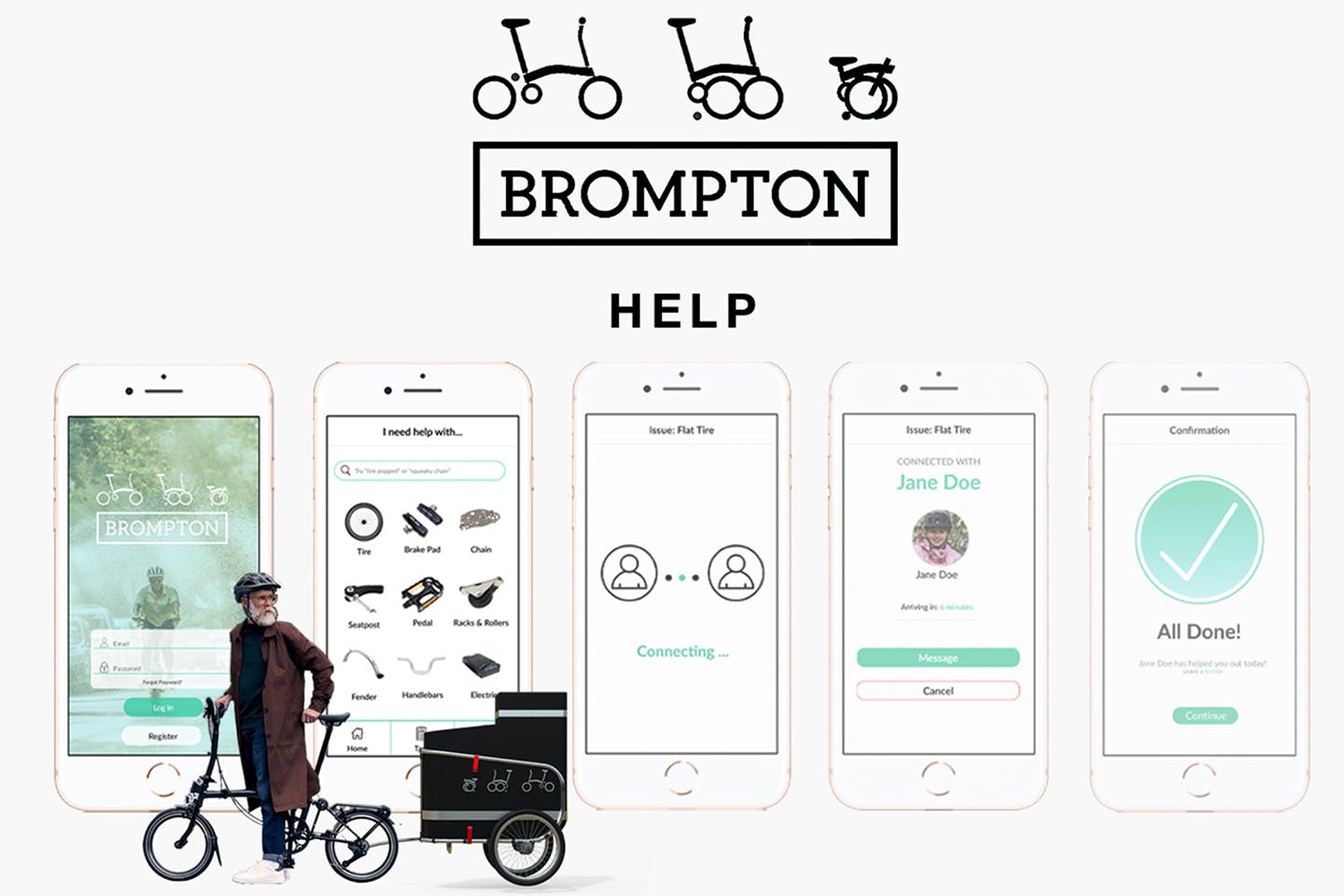
The studio’s undergraduate winners, BFA Product Design students Rachel Joo and Kyleigh Mogilewski, also developed several prototypes side by side, with an eye to making the bicycles accessible for Disabled and older people. After working on a raincoat that snaps together with magnets and developing several carrier devices, they opted to create a portable repair station and app that match cyclists requiring service with a network of Brompton-certified mobile mechanics.
“If I need to solder an electronic piece for my prototype, there’s a workshop at Parsons for that. If I need to get help dyeing textiles, I can go to the Fashion Design department. Parsons uniquely allows multidisciplinary work for partnered problem solving,” Mogilewski says of the project’s development. “Brompton was impressed by the level of rigor that Parsons brought to the project,” Michalik says.
Chorpash attributes the success of the Brompton partnership in part to the company’s heritage of progressive innovation paired with the public’s increasing embrace of design that promotes social and environmental good. “I think it’s less that Parsons has changed in the last decade or two than it is that the level of consciousness in the world has changed,” Chorpash says. He notes that the collaboration with Parsons helped Brompton amplify its social impact while benefiting financially. “This is a moment not of critique, but of imagining another future.” Chorpash points out that “the role of the university is not just professional training. It’s to help shape the world we live in. That’s the scholarship our faculty is working on.”