Jessica Pisano
Professor of Politics
Email
pisanoj@newschool.edu
Office Location
D - 6 East 16th Street
Profile
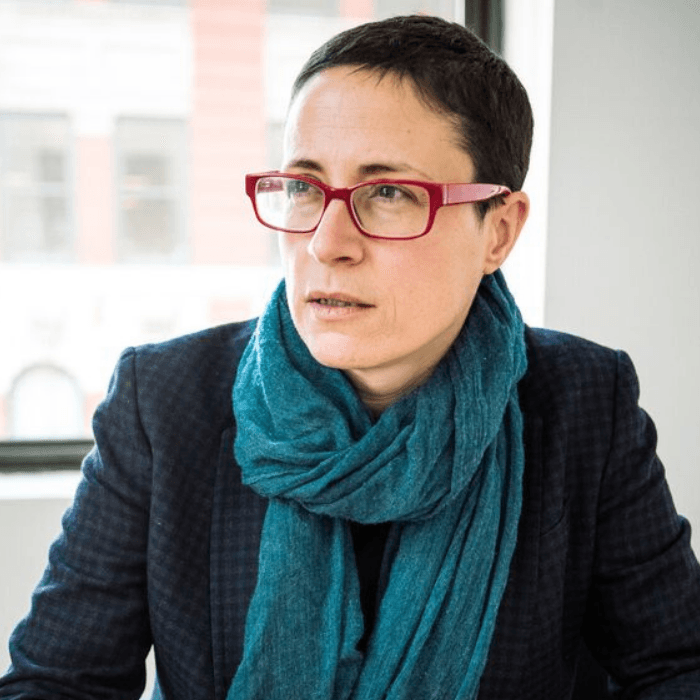
Jessica Pisano is Professor of Politics at The New School for Social Research. She writes and teaches about contemporary and twentieth century politics and political economy in Eastern Europe. Her work focuses on the enclosure of public resources, the constitution of material and social power, and political and social processes of dispossession. She asks how shifts in political economy affect people's lives, and how those effects translate into changes in local, national, and global politics. Her research is interdisciplinary, drawing on archival sources as well as a variety of immersion-based methods, including participant-observation research. She writes and lectures in English, French, Ukrainian, and Russian.
Professor Pisano is the author of Staging Democracy: Political Performance in Ukraine, Russia, and Beyond (Cornell University Press, 2022) and The Post-Soviet Potemkin Village: Politics and Property Rights in the Black Earth (Cambridge University Press, 2008), which received the Harvard University Davis Center Book Prize in Political and Social Studies in 2009. She is writing a book about place and belonging under fascism, state socialism, and neoliberal democracy on a single street in Eastern Europe between 1938 and 2014. Her public-facing work on American, Ukrainian, and Russian politics has appeared in Politico and The Washington Post, among others. She is a 2024 Guggenheim Fellow.
More information is available at Professor Pisano's personal website.
Degrees Held
PhD 2003, Yale University
AB 1994, Harvard College
Recent Publications
Books
Staging Democracy: Political Performance in Ukraine, Russia, and Beyond. 2022. Cornell University Press.
The Post-Soviet Potemkin Village: Politics and Property Rights in the Black Earth. 2008. Cambridge University Press. Winner of the AAASS (ASEEES) Davis Center Book Prize in Political and Social Studies.
Articles and Book Chapters
“Ethnography,” in Jennifer Cyr and Sara Wallace Goodman, eds. Doing Good Qualitative Research. (Oxford: Oxford University Press, forthcoming).
"De la polarisation à une communauté nationale résiliente: Changements au sein de la société ukrainienne en temps de guerre," in Le Canada à l'aune du conflit en Ukraine (Québec Presses de l'Université Laval, 2024).
"Volodymyr Zelenskyy's Vision of Ukrainian Nationhood," Journal of Peace and War Studies, October 2022, pp. 187-198.
"How Zelensky Has Changed Ukraine," Journal of Democracy, July 2022.
“Post-Soviet or Eurasian Lands? Rethinking Analytic Categories in the Ukraine-EU and Russia-China Borderlands” (with André Simonyi), in Tone Bringa and Hege Toje, eds. Eurasian Borderlands: Spatializing borders in the aftermath of state collapse" (New York: Palgrave MacMillan, 2016), pp. 27-57.
"Pokazukha and Cardiologist Khrenov: Soviet Legacies, Legacy Theater, and a Usable Past,” in Mark Beissinger and Stephen Kotkin, eds. Historical Legacies of Communism in Russia and Eastern Europe. (New York: Cambridge University Press, 2014), pp. 222-242.
“Opting Out under Stalin and Khrushchev: Post-War Sovietization in a Borderlands Magyar Village,” Problems of Post-Communism, 58:1 (January-February 2011), pp. 58-66.
“The Social Life of Borders: Political economy at the edge of the EU” (with A ndré Simonyi) in Joan DeBardeleben and Achim Hurrelmann (eds.), Transnational Europe: Promise—Paradox—Limits (Palgrave, 2011), 222-238.
“Social contracts and authoritarian projects in post-Soviet space: The use of administrative resource” Communist and Post-Communist Studies, 43:4 (2010), pp. 373-382.
“Legitimizing facades: Civil Society in post-Orange Ukraine” in Paul D’Anieri (ed.), Orange Revolution and Aftermath: Mobilization, Apathy, and the State in Ukraine (Woodrow Wilson Center Press and Johns Hopkins University Press, 2010), pp. 229-253.
“From Iron Curtain to Golden Curtain: Remaking Identity in the European Union Borderlands,” East European Politics and Societies , 23:2 (May 2009), pp. 266-290. Winner of Hungarian Studies Association Mark Pittaway prize.
“How to Tell an Axe Murderer: An Essay on Ethnography, Truth, and Lies,” in Edward Schatz (ed.), Political Ethnography: What Immersion Contributes to the Study of Power (Chicago, IL: University of Chicago Press, 2009), pp. 53-73. Co-recipient of American Political Science Association Giovanni Sartori Award.
“Property: What is it good for?” Social Research, 76:1 (Spring 2009), pp. 175-202.
“The Two Faces of Petr Arkad’evich: Land and Dispossession in Russia’s Southwest, ca. 2000,” International Journal of Labor and Working Class History, (Spring 2007), pp. 70-90.
“Klychkov i Pustota: Post-Soviet Bureaucrats and the Production of Institutional Facades,” in Thomas Lahusen and Peter Solomon (eds.), What is Soviet Now? Identities, Legacies, Memories (London: LIT Verlag, 2007), pp. 40-56.
“‘Friendship of Peoples’ After the Fall: Violence and Pan-African Community in Post-Soviet Moscow” (with Eric Allina-Pisano) in Maxim Matusevich (ed.), Africa in Russia, Russia in Africa: 300 Years of Encounters (Trenton, New Jersey: Africa World Press, 2006), pp. 175-198.
“Sub Rosa Resistance and the Politics of Economic Reform: Land Redistribution in Post-Soviet Ukraine,” World Politics,56:4 (July 2004), pp. 554-81.
“Land Reform and the Social Origins of Private Farmers in Russia and Ukraine,” Journal of Peasant Studies, 31:3 (July 2004).489-514.
“Agrarnye reformy v Rossii i na Ukraine: sravnitel’nyi analiz,” Otechestvennye zapiski, 4:1 (March 2004), 1-12.
“Reorganization and its Discontents: A Case Study in Voronezh oblast’,”in David O’Brien and Stephen Wegren (eds.), Rural Reform in Post-Soviet Russia (Washington, D.C. and Baltimore: Woodrow Wilson Center Press and Johns Hopkins University Press, 2002), pp 298-324. Essays and Shorter Pieces
"The Only Way War in Ukraine Can End. On Jessica Pisano's Staging Democracy and the function of political theater," Public Seminar, March 28, 2023.
"Notes on Kharkiv. An ethnographer's reflections on communication in wartime," Public Seminar February 23, 2023.
"Why Volodymyr Zelenskyy is a More Complex Leader Than Most People Know," Politico Magazine, February 23, 2023.
"Why didn't Putin invade under Trump? It wasn't personal," Politico Magazine, March 2, 2022.
"Yes, Putin cares about Trump’s impeachment trial–but not for the reason you might imagine,” The Monkey Cage, The Washington Post, January 24, 2020.
“Why Ukraine’s president said there had been ‘no pressure’ from Trump,” Impeachment Inquiry and The Monkey Cage, The Washington Post, November 22, 2019.
"Trump says he was looking for corruption in Ukraine — where President Zelensky was known for mocking corruption in Ukraine,” The Monkey Cage, The Washington Post, November 14, 2019.
"Teatr po prinuzhdeniiu. Pochemu podderzhka vlasti na Ukraine i v Rossii imeet malo obshchego c demokratiei ili avtoritarizmom. Poteria obshchego iazyka v razgovorakh o politike proiskhodit ne tol’ko v rezul’tate ideologicheskikh usilii vlasti” [Theatre under duress: Why support for the authorities in Ukraine and Russia has little in common with democracy or authoritarianism. The loss of a common language in conversations about politics is occurring not only due to the ideological efforts of the powers that be], Republic (Moscow), April 25, 2019, https://republic.ru/posts/93616.
"Potemkin Villages,” in The Global Encyclopedia of Informality. Alena Ledeneva, ed. University College London Press, 2018, Volume 2, pp. 278-280.
"Tug of War: Notes from the Battlefield of Reflexivity,” Cultural Anthropology, November 2014.
Current Courses
- Demagogues and Dictators
GPOL 5050 - Fall 2026 - Independent Study
GPOL 6990 - Fall 2026 - Directed Dissertation Study
GPOL 7991 - Fall 2026 - Ind Senior Prject
LPOL 4990 - Fall 2026
Future Courses
- Independent Study
GPOL 6990 - Spring 2027 - Directed Dissertation Study
GPOL 7991 - Spring 2027 - Independent Study
LPOL 3950 - Spring 2027 - Ind Senior Prject
LPOL 4990 - Spring 2027 - Russia and America
ULEC 2642 - Spring 2027
Past Courses
- The Politics of Money
GPOL 6478 - Spring 2026 - Independent Study
GPOL 6990 - Spring 2026 - Directed Dissertation Study
GPOL 7991 - Spring 2026 - Independent Study
LPOL 3950 - Spring 2026 - Ind Senior Prject
LPOL 4990 - Spring 2026 - Russia and America
ULEC 2642 - Spring 2026