At Parsons, our faculty of leading artists, designers, and scholars lead change both in the classroom and in their industries. They work directly with you, building your skills and professional networks. And they develop new ways to make online learning productive and classroom communities close. On our Faculty Stories page, you can explore faculty accomplishments and projects with students.


Join us for a short lecture from Collective Fashion Justice founding director, Emma Håkansson about total ethics fashion, high impact materials, methane emissions, how climate and ethics intersect, and the material solutions we can use to create a more responsible fashion future. The lecture will be followed by a screening of short film, SHIRINGA: Fashion Regenerating Amazonia, and a panel discussion between Emma, Parsons’ John Bartlett, and material innovator Stephanie Downs, CEO and co-founder of Uncaged Innovations.

Crystal Z Campbell, 2021 Guggenheim Fellow in Fine Arts, is a visual artist, experimental filmmaker, and writer of Black, Filipinx, and Chinese descents whose archive-driven works center the psychogeographic, historical perception, and the underloved. Campbell’s films and visual art have screened and exhibited internationally: European Media Arts Festival, SFMOMA, Chicago International Film Festival (Silver Lion), National Gallery of Art, MIT List Center, International Film Festival Rotterdam, Berlinale, MOMA, St. Louis Museum of Art, Studio Museum of Harlem, Artists Space, Bemis, Block Museum and others. Campbell has received honors from NYFA/NYSCA Fellowship, Creative Capital, Harvard Radcliffe Fellowship, Pollock-Krasner, Skowhegan, Rijksakademie, and Whitney ISP program. Campbell is an Associate Professor at the University at Buffalo who lives between Oklahoma and New York.Part of the Fine Arts Visiting Artist Lecture Series
In 2025, New York City legalized Accessory Dwelling Units (ADUs) citywide to help address its housing crisis. But in an era of climate change, this raises an urgent question: what should we actually build these small houses out of? This exhibition offers an alternative to building practices steeped in petroleum- and plastic-based products. Organized around three material types—fiber, mineral, and timber—student teams from Parsons’ Master of Architecture Design Workshop reimagined the future of New York City’s ADUs as healthier for people, place, and planet. The result is three prototypical designs that push the architectural possibilities of biogenic and geogenic materials to their limit.FIBERTeam: Gianni Grieco, Harshal Rajdeo, Amyri WilliamsMINERALTeam: Nash Boursiquot, Ben Holstine, Bella James, Michael WilsonTIMBERTeam: Amy Bass, Max Czysz, Nia Murray, Anmol Patel Professors: David Lewis & Dr. Sharon E. Sutton Funding for this work graciously provided by the Durst Family.Visit Designing With: Parsons School of Design’s Partnered Design-Build Projects for more information.

The Center for the American Experience invites you to join Rhae Lynn Barnes, Assistant Professor of History at Princeton University, and Jonathan Square, Assistant Professor of Black Visual Culture at Parsons, for a discussion of Barnes's book Darkology: Blackface and the American Way of Entertainment. Darkology is a major study of the history of blackface minstrelsy in the United States, showing how deeply it shaped American entertainment, institutions, and racial politics from the nineteenth century through the Civil Rights era and beyond. Drawing on extensive archival research, Barnes challenges the idea that blackface was marginal or short-lived, revealing instead how widely it spread across schools, churches, universities, military spaces, and public life.

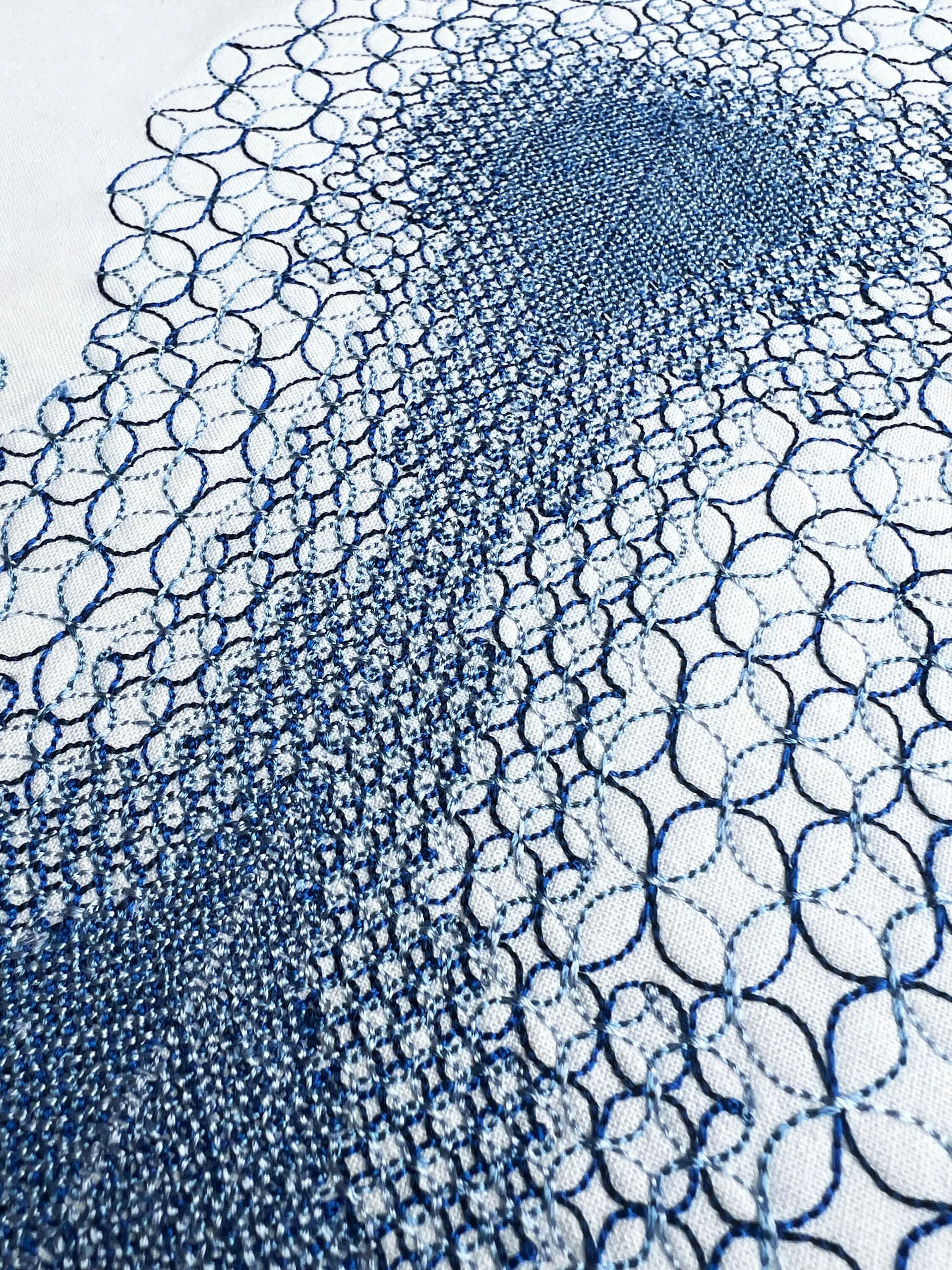
For New York Textile MonthWith Anette Millington, Travis Fitch, and Ragna FrodaTuesday, September 29th from 12 pm - 2 pmKellen AuditoriumRSVP is required This artist/designer talk focuses on digital embroidery in creative work, expanding industrial applications to uncover unique human sensitivities of the machine stitch. The conversation will bring together Response Patterns, a collaborative project by Anette Millington and Travis Fitch, and artist Ragna Froda, to discuss experimentation, machine collaboration, and embroidered materiality. Response Patterns is a collaborative project that leverages Anette Millington’s expertise in pattern and print, and textile embellishment, with Travis Fitch’s in-depth knowledge of digital tools, geometry, 3D-printed embellishment, and architectural design. The ongoing study of geometric and biological patterning informs their research on machine embroidery. Considering the language of patterning- units, symmetries, and algorithmic scale- they work with the embroidery machine to create tactile symbols and surfaces. Ragna Froda is an Icelandic artist, curator, and educator with a background in fashion/ textile design. Her work focuses on the process of making, working with colors and textures, and the history and culture of symbols and patterns in textiles. Ragna will discuss her “Here we go again” series of digital embroideries. The artwork, originally sketched in ink, undergoes a transformation through embroidery, guided by her assistant Bobby, the embroidery robot. As a team, they explore life events, histories, and dreams. The talk will highlight shared interests in material experimentation to expand the lexicon of machine embroidery and add emotive and temporal qualities. Examples include the use of environmentally responsive materials, such as UV-sensitive threads, and textural substrates made from fabric collage and quilting. The conversation will also focus on interventions and design processes for working with digital embroidery software and improvisation between machine and maker. Presented by MFA Textiles
The New School admits students of any race, color, national and ethnic origin to all the rights, privileges, programs, and activities generally accorded or made available to students at the school. It does not discriminate on the basis of race, color, national and ethnic origin in administration of its educational policies, admissions policies, scholarship and loan programs, and athletic and other school-administered programs.